Setting -outline for pit lines

Hi all, Feeling like a beginner here with a very simple question, but oh well... "-outline out" is for outer walls "-outline in" is for pillars in the middle of a passage When a wall line is drawn in the wrong direction, you hit "reverse" to make the little tick point inwards. Easy. Until you hit this wording in the old tutorials: "The "outline" option specifies on which side of a line there is the rock." With a *pit* line that is being drawn with its tines facing outwards - as in, the scrap ends at the top of a pitch - the little tick also points outwards, in the opposite direction to most wall lines. ____________________ |- Scrap to pitch head |- A different scrap starts below the pitch ____________________|- Therion doesn't seem to care whether you set "-outline" for that pit to "out" or "in", the result is the same in most cases when creating PDF. Except when creating a .lox file, where it will complain about the scrap outline being invalid if you use "in". So what is the correct value for -outline on a pit with the tines pointing out, when the scrap outline should be the pit's line? And if it is "-outline out", then why do we always draw walls with the tick pointing inwards - surely if it is valid for a pit line to have the tick pointing out and "-outline out", then it is also valid for wall lines to be drawn that way too, so why don't we? Cheers, Tarquin

11. 12. 2019 v 14:57, Tarquin Wilton-Jones via Therion <therion@speleo.sk>:
And if it is "-outline out", then why do we always draw walls with the tick pointing inwards - surely if it is valid for a pit line to have the tick pointing out and "-outline out", then it is also valid for wall lines to be drawn that way too, so why don't we?
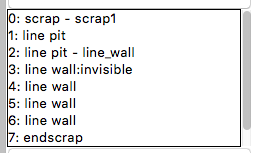
Line pit in common case has small ticks in the dirrection of yellow tick of line. It means their dirrection is to „air“ or „empty space“. You may not specify attribute -outline in case of pit. Only exception is if you want your pit should be transparent and the lover lever is visible. In that case you should use -outline out attribute (and -clip off attribute too). In your case it is probably more correct to start line pit in the end point of line wall, draw it back to that point. It will create line with parameter close on. First of all uncheck button close. Than use right button on point on end of second line wall and split line pit. As result there will be line pit which is the scrap outline. Ad attribute -clip off and ID to it to recognize it in .th2 file. Open .th2 file in text editor and copy that particular line pit just under the original line pit. Rename it to wall, remove ID and add attribute -visibility off. Check in the map editor if the yellow tick of that invisible line is pointing inside the passage. Martin
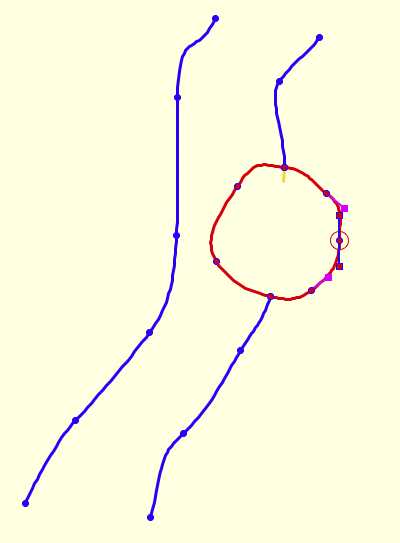
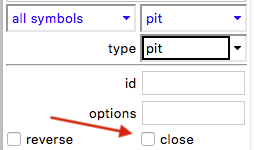
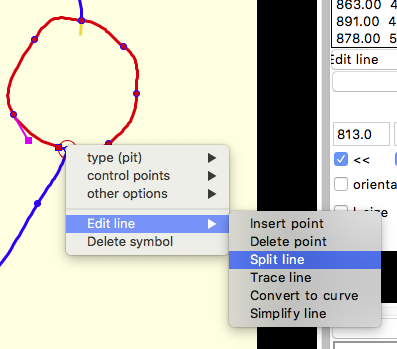
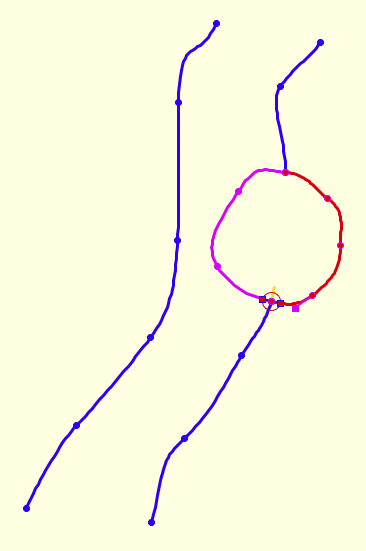
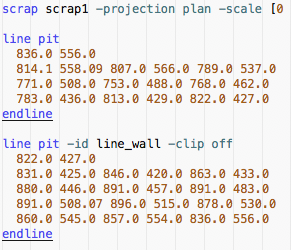
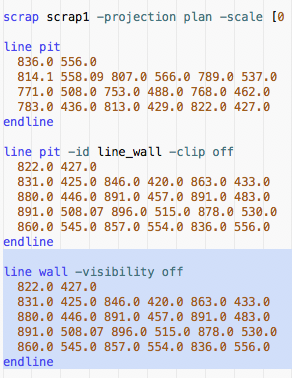
You may not specify attribute -outline in case of pit.
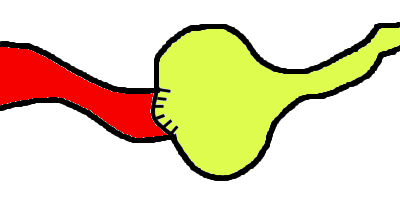
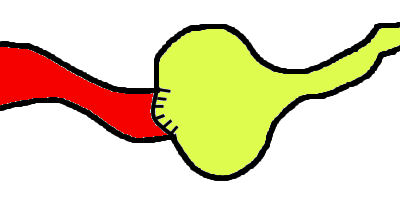
Why not? It is perfectly normal for a passage to end at a pit, and that pit therefore becomes a line that terminates a passage. I have attached a hand drawn example of how this would appear normally on a plan view (at least, this is how it would normally appear on a plan survey in the UK, such as the survey of a pothole - vertical cave - like Swinsto or Simpson's). "-outline in" does work on the pit line here for generating a PDF. But shows a warning when generating LOX. "-outline out" also works without a warning when generating LOX or when generating PDF. What I don't understand is 1. Whether "-outline out" is actually the correct thing to use when the pit line points outwards rather than inwards. 2. Why it even matters which way we draw a *wall*, if "outline out" always can pick the "correct" side to fill. Surely if it can work out the "correct" side of a pit line, it can also work out the correct side of a "wall" line, and it doesn't even matter whether the yellow tick points towards "air" or "rock". (Having to have an invisible wall on the lower scrap makes complete sense to me though, since that has to have a curved wall matching the curve of the pit line above. This is what I already use.)
11. 12. 2019 v 16:59, Tarquin Wilton-Jones via Therion <therion@speleo.sk>:
1. Whether "-outline out" is actually the correct thing to use when the pit line points outwards rather than inwards.
2. Why it even matters which way we draw a *wall*, if "outline out" always can pick the "correct" side to fill. Surely if it can work out the "correct" side of a pit line, it can also work out the correct side of a "wall" line, and it doesn't even matter whether the yellow tick points towards "air" or "rock".
If I understand the problem: Orientation of line has essential importance in Therion. Normaly, everything what is on right side of line wall as you draw it is bedrock (if you don’t define colour map-bg it will be white in PDF). The reverse command has been added later just need not to redraw the wall with correct orientation. Before that only way was to delete such line and redraw it. Normaly the line wall has empty space on side of yellow tick, bedrock on oposite side. Outline is by default defined only for wall. You may use -outline in or -outline out for other lines as well. In your case you has two scraps. Upper scrap ends with pit. If you don’t define outline Therion will connect ends of passage and there will be red sickle and part of little ticks of line pit will be clipped. If you use for line pit -outline out and -clip of Therion will use this line as line wall and clip everything on oposite side as yellow tick is. Clip of means that small ticks, part of symbol line pit, will not be clipped. Because you has second scrap under the first one it willl look as the end of first scrap after pit is transparent. Martin

Tarquin I think Martin is right. And your example illustrates it well. Your drawing shows two scraps, the red scrap should have a line at the pit of -outline out. The green scrap should have a line at the pit of -outline out. Outline in or outline none has no place in this example. Whether these scrap end lines (margin between red and green) are invisible walls or pit lines is a different consideration, and could be handled a number of ways. The line pit itself could be in either scrap (or both, but preferably not). Maybe it is like this: * Line orientation (yellow tick) primarily controls orientation of line ornamentation. By convention it doubles as a way to determine the interior of an object (rock, passage) or the free-space side of the line. Usually these two criteria correlate perfectly (think of line wall:sand or line pit), but sometimes these criteria are in conflict, and the draughtsperson needs to get creative! * Line outline attribute is primarily for definition of the interior of a scrap. This differs subtly from thinking of it as the interior of a passage. Imagine a passage and oxbow. If they are all drawn as one scrap, the interior wall must be -outline in. If they are drawn as two or more scraps, all the walls must be -outline out. In some cases Therion can already compensate for user error, and maybe in future it might be appropriate to automate it. * These are two separate considerations that are (and should continue to be) handled independently (whether by the user manually or automatically by the software).
1. Whether "-outline out" is actually the correct thing to use when the pit line points outwards rather than inwards.
As per the points above. They are two mostly independent considerations.
2. Why it even matters which way we draw a *wall*, if "outline out"
As you have picked, the pdf engine can solve the problem of what is the inside of a passage more often than the 3d model engines. Perhaps in theory better coding would make the outline attribute redundant. For now, giving users the outline attribute gives them control. Bruce -----Original Message----- From: Therion <therion-bounces@speleo.sk> On Behalf Of Tarquin Wilton-Jones via Therion Sent: Thursday, 12 December 2019 04:59 To: therion@speleo.sk Cc: Tarquin Wilton-Jones <tarquin.wilton-jones@ntlworld.com> Subject: Re: [Therion] Setting -outline for pit lines
You may not specify attribute -outline in case of pit.
Why not? It is perfectly normal for a passage to end at a pit, and that pit therefore becomes a line that terminates a passage. I have attached a hand drawn example of how this would appear normally on a plan view (at least, this is how it would normally appear on a plan survey in the UK, such as the survey of a pothole - vertical cave - like Swinsto or Simpson's). "-outline in" does work on the pit line here for generating a PDF. But shows a warning when generating LOX. "-outline out" also works without a warning when generating LOX or when generating PDF. What I don't understand is 1. Whether "-outline out" is actually the correct thing to use when the pit line points outwards rather than inwards. 2. Why it even matters which way we draw a *wall*, if "outline out" always can pick the "correct" side to fill. Surely if it can work out the "correct" side of a pit line, it can also work out the correct side of a "wall" line, and it doesn't even matter whether the yellow tick points towards "air" or "rock". (Having to have an invisible wall on the lower scrap makes complete sense to me though, since that has to have a curved wall matching the curve of the pit line above. This is what I already use.)
By convention it doubles as a way to determine the interior of an object (rock, passage) or the free-space side of the line.
Thank you! This seems to have sealed the idea in my head. It's a convention because it matters with some ornamentations. And it almost always makes sense because the tick points towards "air". Except when it's a boulder. ;)
As you have picked, the pdf engine can solve the problem of what is the inside of a passage
Since the line's orientation has little/no effect on where the engine chooses to decide is the "inside" of a structure, this makes me wonder ... Maybe there is a possibility that I can construct a cave where the proximity of openings/entrances and passage curves will cause it to construct the passage on the wrong side of a line. And in such a case, the solution would be to make invisible walls. Interesting. I will probably randomly bump into that, one day. Anyway, thanks for explaining it to me.
Maybe there is a possibility that I can construct a cave where the proximity of openings/entrances and passage curves will cause it to construct the passage on the wrong side of a line. And in such a case, the solution would be to make invisible walls. Interesting. I will probably randomly bump into that, one day.
Scraps with open ends that are wider than they are long is a good start if you want to make things tricky. And yes, invisible walls (or -visibility off) is the solution. Details here https://therion.speleo.sk/wiki/drawingchecklist?s[]=scrap#wall Bruce
participants (3)
-
 Bruce Mutton
-
 Martin Sluka
-
 Tarquin Wilton-Jones