
Hi there! I am about to adapt the symbol-set in therion to meet the Austrian standard (see http://www.hoehle.org/downloads/signaturen.gif). The changes I made, can be found here: ftp://ftp.tugraz.at/outgoing/therion/symbolsetAUT_changes.zip and an example of what comes out: ftp://ftp.tugraz.at/outgoing/therion/types_AUT.pdf Most symbols are finished already (or met the standard anyway), but there are still some open issues: -Drawing the symbol for entrance pits which uses a double line. Currently I generate points at a fixed distance perpendicular to the given line and connect them to form the inner line. This results in very bad behaviour at edges, and needs a lot of memory due to the large number of generated points. Any ideas how to solve that? -Naming of floorstep subtypes: As in the old UIS standard(?) there are floorstep subtypes when equipment is needed (<10m, >10m). Any ideas for a good (short) name for those? -Legend symbols/explanations. I didnt really care about that yet. And the main question is: - How shall I prepare the changes I did, such that they can be easily included in one of the next releases? Keep up the good work and kind regards Georg.

On 25.11.2008, at 23:22, Georg Pacher wrote:
-Drawing the symbol for entrance pits which uses a double line. Currently I generate points at a fixed distance perpendicular to the given line and connect them to form the inner line. This results in very bad behaviour at edges, and needs a lot of memory due to the large number of generated points. Any ideas how to solve that?
Simple trick: thick black line at background and thin white line at foreground on the identical path. Martin
Martin Sluka schrieb:
On 25.11.2008, at 23:22, Georg Pacher wrote:
-Drawing the symbol for entrance pits which uses a double line. Currently I generate points at a fixed distance perpendicular to the given line and connect them to form the inner line. This results in very bad behaviour at edges, and needs a lot of memory due to the large number of generated points. Any ideas how to solve that? Simple trick: thick black line at background and thin white line at foreground on the identical path.
Good idea, yet I forgot to mention that the outer line should be thicker (like a wall), than the inner line (pit). An 'asymmetric pen' could solve that, but I dont know if that is possible... regards Georg
On 26.11.2008, at 11:15, Georg Pacher wrote:
Good idea, yet I forgot to mention that the outer line should be thicker (like a wall), than the inner line (pit). An 'asymmetric pen' could solve that, but I dont know if that is possible...
I'm affraid that this is unpossible in MetaPost - PostScript use only the central line on path. Maybe somebody else knows another trick. m.
On 26.11.2008, at 11:15, Georg Pacher wrote:
but I dont know if that is possible...
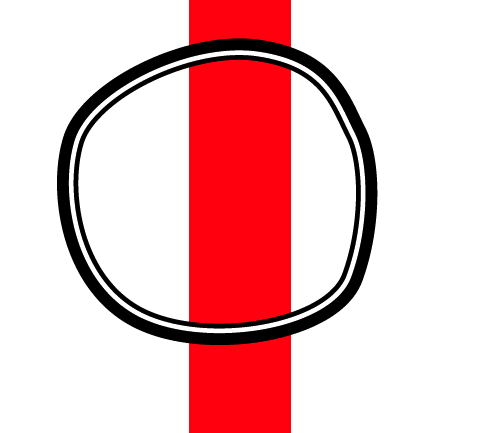
I'm able to do it in Illustrator, but how to program it for MetaPost? from bottom: 1. Make path. 2. Make thickest line on path. 3. Make mask on that path - it should cut the inner part of line 4. Make thick line on path 5. Make thin white line on path m.
example: m. On 26.11.2008, at 11:25, Martin Sluka wrote:
On 26.11.2008, at 11:15, Georg Pacher wrote:
but I dont know if that is possible...
I'm able to do it in Illustrator, but how to program it for MetaPost?
from bottom:
1. Make path.
2. Make thickest line on path.
3. Make mask on that path - it should cut the inner part of line
4. Make thick line on path
5. Make thin white line on path
m. _______________________________________________ Therion mailing list Therion@speleo.sk http://mailman.speleo.sk/mailman/listinfo/therion
Martin Sluka schrieb:
I'm able to do it in Illustrator, but how to program it for MetaPost?
from bottom:
1. Make path.
2. Make thickest line on path.
3. Make mask on that path - it should cut the inner part of line
4. Make thick line on path
5. Make thin white line on path
Yes, this works well! I'm not sure if it's possible to mask only the path and not the entire enclosed area, but that doesn't matter much I think. One can put the entrance pit to the beginning of the .th2 file. thanks, Georg Ps.: the metapost code I used: def PenXXL = pencircle scaled (2.4*u/10) enddef; def l_pit (expr P) = T:=identity; #draw the two lines pickup PenXXL; thdraw P; thclean P; pickup PenX; thdraw P; pickup PenC; thdraw P withcolor (1,1,1); # draw triangles laenge:= arclength P; symsize:=0.5u; triangle_width:=symsize/2; pair l_triangle; pair f_triangle; pair test; path triangle; path draw_triangle; triangle:= (-triangle_width/2,0) -- (triangle_width/2,0) -- (0,symsize/2) -- cycle; cur:=(symsize); t := arctime (cur) of P; f_triangle := (point t of P +.05u*unitvector(thdir(P,t) rotated 90)); thfill triangle rotated angle thdir(P,t) shifted f_triangle ; l_triangle := f_triangle; for cur=(symsize) step 0.1 until laenge: t := arctime (cur) of P; test := (point t of P +.05u*unitvector(thdir(P,t) rotated 90)); my_dist := distance(test,l_triangle); # show my_dist; if abs(my_dist-symsize) < 0.05u: draw_triangle:=triangle rotated angle thdir(P,t) shifted test; if xpart (draw_triangle intersectiontimes P) < 0: thfill triangle rotated angle thdir(P,t) shifted test; l_triangle:= test; fi; fi; endfor; enddef;

I am about to adapt the symbol-set in therion to meet the Austrian standard (see http://www.hoehle.org/downloads/signaturen.gif).
Thanks for your contribution.
-Drawing the symbol for entrance pits which uses a double line. Currently I generate points at a fixed distance perpendicular to the given line and connect them to form the inner line. This results in very bad behaviour at edges, and needs a lot of memory due to the large number of generated points. Any ideas how to solve that?
Currently, there is no solution for this in metapost. The problem is, that there is no analytical solution for creating parralel bezier curve. One solution could be as Martin suggested, but we you approach you are using in some symbols where this is needed (e.g. floor meander).
-Naming of floorstep subtypes: As in the old UIS standard(?) there are floorstep subtypes when equipment is needed (<10m, >10m). Any ideas for a good (short) name for those?
Well, currently we have 3 symbols in therion: floor-step (for steps where no equipement is needed), pit (= step where equipement is needed) and overhang. As far as I understand Austrian symbol set - your floorstep:filled/unfilled should be applied to pit symbol, not floorstep symbol. But are you really in reality using different symbols for pits over and under 10 m, especially when there is allways number right beside the symbol? How is it in other countries - do other people have experience with using different symbols for different pit depths? For me the correct solution for this problem would be to add parameter to the pit/floor-step/overhang symbol with assigned depth, that would be automatically shown on the map and available in metapost if you would like to fill/unfill rectangles. Another small issue is chimney/ceiling-step. You have there in your symbol set "+" sign in the middle. If there will be separate height symbol (e.g. +5 m) in the middle of the chimney, there will be two times "+", which will not look very well. Here I would also suggest adding chimney height as an argument to the chimney line and "+" symbol will be shown, only if it will be assigned using this argument.
And the main question is: - How shall I prepare the changes I did, such that they can be easily included in one of the next releases?
Your changes in a zip file are OK. I will diff and patch our sources. Thanks for your contribution, S.
Stacho Mudrak schrieb:
Well, currently we have 3 symbols in therion: floor-step (for steps where no equipement is needed), pit (= step where equipement is needed) and overhang.
As far as I understand Austrian symbol set - your floorstep:filled/unfilled should be applied to pit symbol, not floorstep symbol. I guess you're right, it should be applied to the pit symbol. My first thought was, that a pit symbol should always be a closed line. But as the symbol is the same, a single name makes it simpler.
But are you really in reality using different symbols for pits over and under 10 m, especially when there is allways number right beside the symbol? How is it in other countries - do other people have experience with using different symbols for different pit depths?
I'm checking this with people who were involved in the creation of the standard and use it more frequently than I do...
For me the correct solution for this problem would be to add parameter to the pit/floor-step/overhang symbol with assigned depth, that would be automatically shown on the map and available in metapost if you would like to fill/unfill rectangles.
For the symbol I agree, yet I think the depth label should be placed manually for a nice position.
Another small issue is chimney/ceiling-step. You have there in your symbol set "+" sign in the middle. If there will be separate height symbol (e.g. +5 m) in the middle of the chimney, there will be two times "+", which will not look very well. Here I would also suggest adding chimney height as an argument to the chimney line and "+" symbol will be shown, only if it will be assigned using this argument.
Yes, I wasn't happy with the '+' in the middle of the chimney anyway...
Your changes in a zip file are OK. I will diff and patch our sources. ok, I'm not sure wheter I'll get the way arguments are passed to metapost, but we'll see...
Thanks for the good suggestions Georg.
participants (3)
-
 Georg Pacher
-
 Martin Sluka
-
 Stacho Mudrak