Version Control Systems and Therion

Eighteen months ago there was some discussion about VCS that people were using with Therion. We have two largish projects and soon to be three people working on their own copies of the files that every now and again I try to merge into a coherent dataset. I suspect it's well passed the time where we should have been using a VCS, but you know how it is. Sometimes it seems easier to run along pushing a bicycle than it is to take the time to choose an appropriate one, and hen learn to ride it. A few VCS options were mentioned, including bazaar http://bazaar-vcs.org/en/ and subversion http://subversion.tigris.org/ In an effort to get more local people involved and ease the learning curve for Therion newcomers I'm thinking that putting all our data on a web page and allowing those working on it to have ftp access. Bearing in mind that I have no experience with any type of automated version control (am downloading bazaar as I write this) is there any advice out there? Best VCS application to use? Are ease of use for learner computer users, ftp, Therion and VCS mutually exclusive? My (sheltered) experience with ftp so far is that it is no more complex than using files on a local disk. Is this a good route or should I try another path? Any feedback or advice welcomed. Cheers Bruce

Hello We are using Mercurial distributed VCS. Main repository maintained by myself, other contributors bring changes to me on flash-cards or send patch-files by email It is possible to get free mercurial hosting: http://mercurial.selenic.com/wiki/MercurialHosting -- WBR, Vasily

Hi At Sun, 15 Nov 2009 10:48:09 +0300, Vasily Vl. Suhachev wrote:
We are using Mercurial distributed VCS. Main repository maintained by myself, other contributors bring changes to me on flash-cards or send patch-files by email
OK, nobody has mentioned git yet, so I'll do it. Frankly I have never really used bazaar or hg (mercurial), but all three are very similar in many respects. For the purpose of tracking files and exchanging them with collegues, only decentralized VC makes sense (maybe with a central repository, but that is not important). CVS is dead, SVN is not very good for that purpose. Two nice short introductions: http://www-cs-students.stanford.edu/~blynn/gitmagic/ http://wiki.sourcemage.org/Git_Guide Have fun Martin

Martin Lüthi wrote:
Hi
At Sun, 15 Nov 2009 10:48:09 +0300, Vasily Vl. Suhachev wrote:
We are using Mercurial distributed VCS...
For the purpose of tracking files and exchanging them with collegues, only decentralized VC makes sense (maybe with a central repository, but that is not important). CVS is dead, SVN is not very good for that purpose.
Huh? That is the primary purpose of SVN, AFAIK. I do agree that CVS is dead. It was adequate, but it is no longer being supported.
Two nice short introductions:
http://www-cs-students.stanford.edu/~blynn/gitmagic/ http://wiki.sourcemage.org/Git_Guide
My previous post may have been lost. I'll try again. SVN is still the most active Revision Control system out there. I think you can set up an account on sourceforge.net for free. I think their favorite system is SVN. They might provide Trac too, which is a nice ticket/bug tracker which integrates with SVN. aaron
Hi again At Sun, 15 Nov 2009 12:49:46 -0700, Aaron Birenboim wrote:
For the purpose of tracking files and exchanging them with collegues, only decentralized VC makes sense (maybe with a central repository, but that is not important). CVS is dead, SVN is not very good for that purpose.
Huh? That is the primary purpose of SVN, AFAIK.
SVN is great for centralized data repositories. I used to use it for several years for all my data, basically synchronizing laptop and desktop, and collaboration on projects. The major drawback (for me) is that you need a connection to the server with the central repository to commit changes. After having switched to git (any distributed VC such as hg or bzr will do), I commit every non-trivial editing/work step locally, and push to my repository (visible to my collaborators, and with daily backups) when I have reached a point where I think it's worth that the collaborators get it (usually daily). Work on new features is done in local branches (very cheap with git), collaborators usually pull my master branch, and I pull theirs. Since there is no central repository, data exchange is less formal and easier. And (the killer argument for me): I have versioning on my local machine, without network connection (of course you can use CVS/RCS, but that does not make sense anymore given the new decentralized VC systems).
I do agree that CVS is dead. It was adequate, but it is no longer being supported.
SVN is still the most active Revision Control system out there. I think you can set up an account on sourceforge.net for free. I think their favorite system is SVN.
Submitting cave survey data to sourceforge.net is dangerous. Sourceforge is world-visible, and I shure don't want the local caving-hero (advertising his caving adventures on the net, without any awe or scientific interest) to know all the details about new discoveries which are visible in plans.
They might provide Trac too, which is a nice ticket/bug tracker which integrates with SVN.
Trac is nice, but I'm not shure how much we would need it for cave survey data (this is what we talk about, isn't it?). Using git, for example, you can publish your repository on any web server space (also password protected), or any shared area on your computer, and just send the URL to your peers. From there they pull your changes, and you can pull theirs from either their repositories, or form a centralized space such as github.com (same cautions as about sourceforge.net apply). Summary: o version control is good (mandatory) o decentralized version control is much better o backups (long term) are a must git (or hg, bzr) provide all of this Best, Martin

I have been working on a larger cave and storing all the survey data in my own program which exports to therion files. For a particular survey the scraps are not being drawn correctly, but drawing just the centerline from the survey data looks fine. Posted here http://mbug.dyndns.org/example/ are two thconfig files, one with the scraps and one without and the generated PDF files. The shot B009-B010 for example looks fine in the just centerline export, but does not show up on the export from scraps (even though it has a scrap which looks correct). Does anybody know why this would be happening? I do not see any errors from therion, even running it with the -d flag, and it appears to me that all the input data is formatted correctly. Thanks, Carl

Carl, I don't know why it doesn't work, but it appears you have created a program to produce walls based on the LRUD. Nice idea! But you can achieve similar just be asking Therion to output the LRUD data in the output map, which is much easier than what you are doing and great for that initial visualisation of the survey data. Therion also accurately reflects the Left-Right values entered, so the cave walls follow the centreline at the correct distances (eg where the centreline zigzigs from left wall to right wall). Regards, - Ben Cooper
I have been working on a larger cave and storing all the survey data in my own program which exports to therion files. For a particular survey the scraps are not being drawn correctly, but drawing just the centerline from the survey data looks fine.
Posted here http://mbug.dyndns.org/example/ are two thconfig files, one with the scraps and one without and the generated PDF files. The shot B009-B010 for example looks fine in the just centerline export, but does not show up on the export from scraps (even though it has a scrap which looks correct).
Does anybody know why this would be happening? I do not see any errors from therion, even running it with the -d flag, and it appears to me that all the input data is formatted correctly.
Thanks,
Carl
_______________________________________________ Therion mailing list Therion@speleo.sk http://mailman.speleo.sk/mailman/listinfo/therion
Thanks for the suggestion but I don't think it would work in my case - I simplified the data to show the problem I was having, but I am actually making a number of different wall types from the LRUD data and as I understand it Therion will only create regular walls from LRUD data. Carl On Nov 16, 2009, at 11:31 AM, ben@caver.plus.com wrote:
Carl, I don't know why it doesn't work, but it appears you have created a program to produce walls based on the LRUD. Nice idea! But you can achieve similar just be asking Therion to output the LRUD data in the output map, which is much easier than what you are doing and great for that initial visualisation of the survey data. Therion also accurately reflects the Left-Right values entered, so the cave walls follow the centreline at the correct distances (eg where the centreline zigzigs from left wall to right wall). Regards, - Ben Cooper
I have been working on a larger cave and storing all the survey data in my own program which exports to therion files. For a particular survey the scraps are not being drawn correctly, but drawing just the centerline from the survey data looks fine.
Posted here http://mbug.dyndns.org/example/ are two thconfig files, one with the scraps and one without and the generated PDF files. The shot B009-B010 for example looks fine in the just centerline export, but does not show up on the export from scraps (even though it has a scrap which looks correct).
Does anybody know why this would be happening? I do not see any errors from therion, even running it with the -d flag, and it appears to me that all the input data is formatted correctly.
Thanks,
Carl
_______________________________________________ Therion mailing list Therion@speleo.sk http://mailman.speleo.sk/mailman/listinfo/therion
_______________________________________________ Therion mailing list Therion@speleo.sk http://mailman.speleo.sk/mailman/listinfo/therion

On 16.11.2009, at 21:07, Carl Magnuson wrote:
Thanks for the suggestion but I don't think it would work in my case - I simplified the data to show the problem I was having, but I am actually making a number of different wall types from the LRUD data and as I understand it Therion will only create regular walls from LRUD data.
What I don't understand is your scraps looked as directly created, without help of xtherion map editor. What was the reason? Therion will make walls from all lines with atribute -wall. You may use LRUD to generate the .xvi file (export map -o map_lrud.xvi) or to add splay points to sketched walls and therion will morf the sketches according the points, etc... m.
They were created by a program of mine I wrote to manage my survey data. I'm surveying some tunnel systems with fairly simple walls (not much in the way of curvature or features) where I want to generate different walls off of LRUD data and not go to the effort of sketching them myself in xtherion. For the example data I posted I changed the wall type to just wall to make sure that it wasn't an issue with one of the custom wall symbols I created (remove that variable from the possible problems). Carl On Nov 16, 2009, at 2:39 PM, Martin Sluka wrote:
On 16.11.2009, at 21:07, Carl Magnuson wrote:
Thanks for the suggestion but I don't think it would work in my case - I simplified the data to show the problem I was having, but I am actually making a number of different wall types from the LRUD data and as I understand it Therion will only create regular walls from LRUD data.
What I don't understand is your scraps looked as directly created, without help of xtherion map editor. What was the reason?
Therion will make walls from all lines with atribute -wall. You may use LRUD to generate the .xvi file (export map -o map_lrud.xvi) or to add splay points to sketched walls and therion will morf the sketches according the points, etc...
m. _______________________________________________ Therion mailing list Therion@speleo.sk http://mailman.speleo.sk/mailman/listinfo/therion
BTW, way you use the Czech language for exported maps? :) m.
BTW, way you use the Czech language for exported maps? :) m.
I use english, but I took out all of my layout commands to make a simpler example. I haven't decided to learn Czech through Therion at least not yet :P Carl On Nov 16, 2009, at 4:08 PM, Martin Sluka wrote:
BTW, way you use the Czech language for exported maps? :)
m. _______________________________________________ Therion mailing list Therion@speleo.sk http://mailman.speleo.sk/mailman/listinfo/therion
There is something very strange with the calibration of scraps. Check the files I created in traditional therion way based on yours ones :) m.

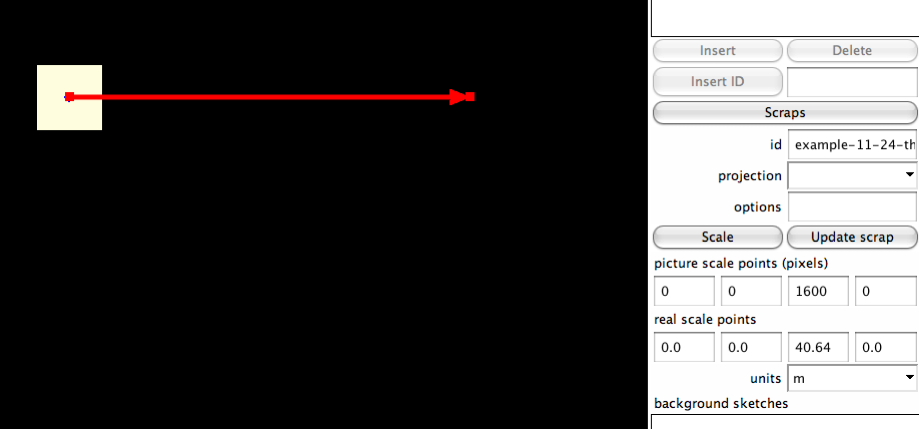

You are saying there is something odd Therion is doing with the calibration? I did try playing around with scale option to see if that helped (no luck) and I also tried scaling the line sizes to be shorter or longer (like 0 .5 1 .5 vs. 0 5 10 5) and the latter seemed to increase the distortion, but scaling it down even more didn't seem to have an impact. Carl On Nov 16, 2009, at 5:11 PM, Martin Sluka wrote:
There is something very strange with the calibration of scraps. Check the files I created in traditional therion way based on yours ones :)
m.
<Picture 1.png><Picture 2.png><Picture 3.png><Archive.zip>_______________________________________________ Therion mailing list Therion@speleo.sk http://mailman.speleo.sk/mailman/listinfo/therion

Bruce If you have beginners, I personally would stick to one that does have a central record somewhere, if you want to support decentralised systems fine, but set it up in a way that the beginners can just log onto the 'central' record and have to 'commit' every change. I have now tried using SVN with at least 3 sets of caving data. Trying to get people to understand a simple update and commit routine is hard enough, without the decentralised options, that I also find confusing. I would only go down that route for expeditions where it is difficult/impossible to talk to the central. If you need it I have a document showing beginner windows users how to set up tortoiseSVN, but it is a few years only now, so the pictures are certainly not the correct ones Andrew

Andrew Atkinson wrote:
Bruce
If you have beginners, I personally would stick to one that does have a central record somewhere, if you want to support decentralised systems fine, but set it up in a way that the beginners can just log onto the 'central' record and have to 'commit' every change. I have now tried using SVN with at least 3 sets of caving data. Trying to get people to understand a simple update and commit routine is hard enough, without the decentralised options, that I also find confusing. I would only go down that route for expeditions where it is difficult/impossible to talk to the central.
I have had that experience. Getting people to use SVN is hard enough. I'd say that to get it to work, the easiest path might be https+svn. (password protected) Getting people to use ssh can be an uphill battle. But somebody needs to host the repository. Using a public service may not be a good idea for survey data. aaron
Martin Lüthi wrote:
Hi again
At Sun, 15 Nov 2009 12:49:46 -0700, Aaron Birenboim wrote:
For the purpose of tracking files and exchanging them with collegues, only decentralized VC makes sense (maybe with a central repository, but that is not important). CVS is dead, SVN is not very good for that purpose. Huh? That is the primary purpose of SVN, AFAIK.
SVN is great for centralized data repositories. I used to use it for several years for all my data, basically synchronizing laptop and desktop, and collaboration on projects. The major drawback (for me) is that you need a connection to the server with the central repository to commit changes.
This can be a good thing. Easier for one person to set up a server than many to establish peers.
After having switched to git (any distributed VC such as hg or bzr will do), I commit every non-trivial editing/work step locally, and push to my repository (visible to my collaborators, and with daily backups) when I have reached a point where I think it's worth that the collaborators get it (usually daily).
Yes. a drawback of SVN is the branching. I'm sure it is easier in GIT, but learning how to use it is tricky. The Suggested SVN method is to work in a branch, commit frequently, then merge back to trunk when you are ready to share. Agreed, this is a pain. Inferior to CVS. I'm glad to hear that GIT addresses this.
Work on new features is done in local branches (very cheap with git), collaborators usually pull my master branch, and I pull theirs.
Since there is no central repository, data exchange is less formal and easier. And (the killer argument for me): I have versioning on my local machine, without network connection (of course you can use CVS/RCS, but that does not make sense anymore given the new decentralized VC systems).
Yea. I often use RCS for local versioning. Then again, I usually have a network, and update repositories often (in branches).
I do agree that CVS is dead. It was adequate, but it is no longer being supported.
SVN is still the most active Revision Control system out there. I think you can set up an account on sourceforge.net for free. I think their favorite system is SVN.
Submitting cave survey data to sourceforge.net is dangerous. Sourceforge is world-visible, and I shure don't want the local caving-hero (advertising his caving adventures on the net, without any awe or scientific interest) to know all the details about new discoveries which are visible in plans.
I wasn't aware survey data was part of this repository. Perhaps I missed part of the conversation. I was thinking about the application source.
They might provide Trac too, which is a nice ticket/bug tracker which integrates with SVN.
Trac is nice, but I'm not shure how much we would need it for cave survey data (this is what we talk about, isn't it?).
Yea. for survey data, somebody would need to provide SVN over SSH.
Using git, for example, you can publish your repository on any web server space (also password protected), or any shared area on your computer, and just send the URL to your peers. From there they pull your changes, and you can pull theirs from either their repositories, or form a centralized space such as github.com (same cautions as about sourceforge.net apply).
Fair enough. With those requirements, perhaps getting people to learn GIT is worth the effort. aaron

Personally I am using bazaar. I think it is more question of if you need centralized only or decentralized solution (with possibility to have central place for "stable" branch). Main advantage of bazaar over subversion is that people can have theirs own local "devel" branches locally placed on laptops and can commit changes offline. For main data repository FTP server can be used = no special needs on server side. There is multiplatform GUI for bazaar - Olive. Bruce napsal(a):
Eighteen months ago there was some discussion about VCS that people were using with Therion. We have two largish projects and soon to be three people working on their own copies of the files that every now and again I try to merge into a coherent dataset.
I suspect it’s well passed the time where we should have been using a VCS, but you know how it is. Sometimes it seems easier to run along pushing a bicycle than it is to take the time to choose an appropriate one, and hen learn to ride it.
A few VCS options were mentioned, including bazaar http://bazaar-vcs.org/en/ and subversion http://subversion.tigris.org/
In an effort to get more local people involved and ease the learning curve for Therion newcomers I’m thinking that putting all our data on a web page and allowing those working on it to have ftp access. Bearing in mind that I have no experience with any type of automated version control (am downloading bazaar as I write this) is there any advice out there?
Best VCS application to use?
Are ease of use for learner computer users, ftp, Therion and VCS mutually exclusive? My (sheltered) experience with ftp so far is that it is no more complex than using files on a local disk. Is this a good route or should I try another path?
Any feedback or advice welcomed.
Cheers
Bruce
------------------------------------------------------------------------
_______________________________________________ Therion mailing list Therion@speleo.sk http://mailman.speleo.sk/mailman/listinfo/therion

As people have realized, getting cavers to understand/use version control systems at all is incredibly difficult. While a distributed version control would be the best answer -- especially in the field -- they are impossible for normal people to use. It will go wrong immediately, and people will get frustrated, and give up. I have had some success getting some non-techies to use TortoiseSVN (they're all on Windows) and knowledgeforge, under the following project: http://knowledgeforge.net/project/sesame/ The majority of the data can be SVN checked out from: http://knowledgeforge.net/sesame/club/mmmmc/ The files are broken into survex data, scans of survey drawings, and tunnelx (sssssssss!) files. The terms of use of this server is it's public data -- as it should be. Personally, I believe there are very few reasons for cave data not to be public, but you can't convince everyone about what is right. If you look around the data on knowledgeforge, you will find that club/hmg is password protected. This is because it is http://www.hongmeigui.net/ data for Chinese caves, and there was a recent government decree that made it illegal for foreigners to make any maps in China. This is one of the very few legitimate reasons for keeping cave data private. If anyone wants to join knowledgeforge and upload sets of cave data, I can add them to the project. As I said, this particular platform has legs. That is, non-techie cavers are routinely committing files to it. This is the big breakthrough. Julian. On Sat, Nov 14, 2009 at 9:50 PM, Bruce <dangle@tomo.co.nz> wrote:
Eighteen months ago there was some discussion about VCS that people were using with Therion. We have two largish projects and soon to be three people working on their own copies of the files that every now and again I try to merge into a coherent dataset.
I suspect it’s well passed the time where we should have been using a VCS, but you know how it is. Sometimes it seems easier to run along pushing a bicycle than it is to take the time to choose an appropriate one, and hen learn to ride it.
A few VCS options were mentioned, including bazaar http://bazaar-vcs.org/en/ and subversion http://subversion.tigris.org/
In an effort to get more local people involved and ease the learning curve for Therion newcomers I’m thinking that putting all our data on a web page and allowing those working on it to have ftp access. Bearing in mind that I have no experience with any type of automated version control (am downloading bazaar as I write this) is there any advice out there?
Best VCS application to use?
Are ease of use for learner computer users, ftp, Therion and VCS mutually exclusive? My (sheltered) experience with ftp so far is that it is no more complex than using files on a local disk. Is this a good route or should I try another path?
Any feedback or advice welcomed.
Cheers
Bruce
_______________________________________________ Therion mailing list Therion@speleo.sk http://mailman.speleo.sk/mailman/listinfo/therion
participants (11)
-
 Aaron Birenboim
-
 Aaron Birenboim
-
 Andrew Atkinson
-
 ben@caver.plus.com
-
 Bruce
-
 Carl Magnuson
-
 Julian Todd
-
 Ladislav Blazek
-
 Martin Lüthi
-
 Martin Sluka
-
 Vasily Vl. Suhachev