
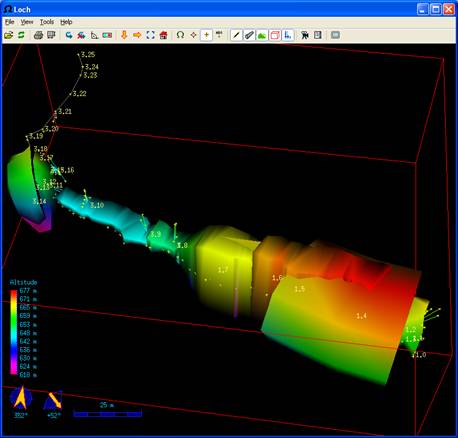
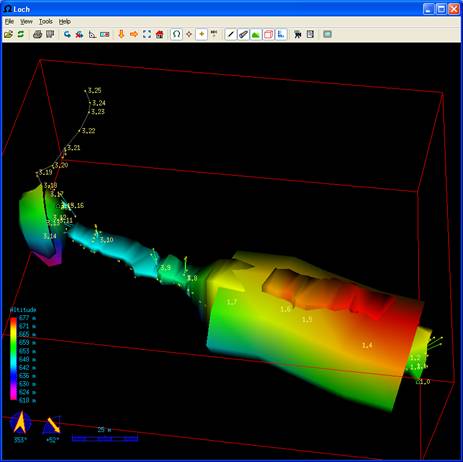
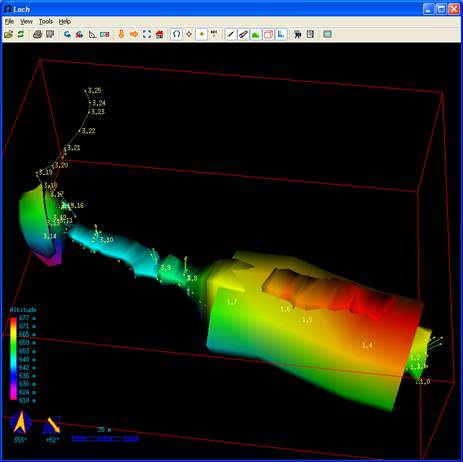
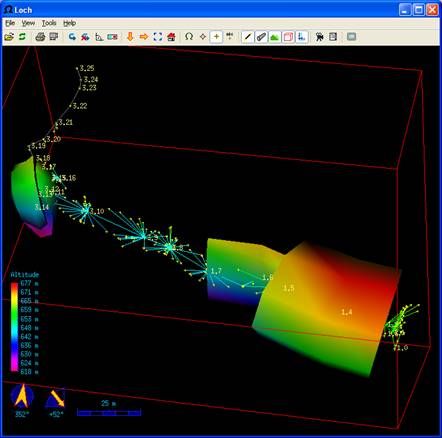
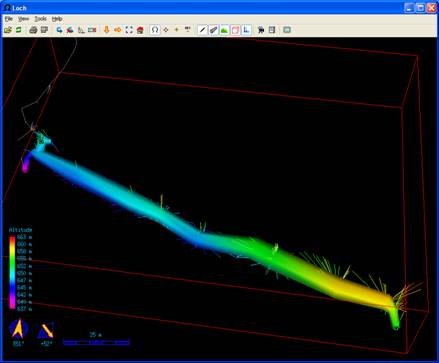
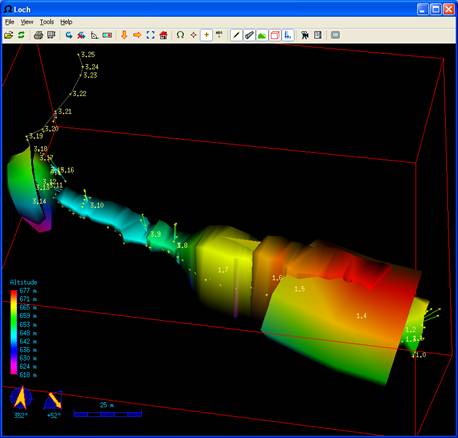
Footleg I think the answer is 'yes'. Hopefully you can view the images embedded in the image rather than attached, otherwise this won't make much sense. In this example there is a single centreline (comprising both cave and surface survey) and 4 scraps. A short section of cave at the left hand end does not have any scrap drawn. Compiled with Therion 5.3.11 One interesting point is that regardless of the 'walls' setting, there is never a tube generated there once we have scraps drawn anywhere in this centreline. My deduction is that Loch uses only one type of tube generation per centreline, because in almost all my larger projects that transition between traditional survey and paperless survey, I have a combination of each type of tube generation within the same Loch model. This fits with the description in the Therion Book "walls <auto/on/off> turn on/off passage shape generation from LRUD data for subsequent shots. If set auto, passage is generated only if there is no scrap referencing given centreline." In these examples I have not used any 'point passage-height' or 'point dimensions' in the scraps. Paperless survey (no LRUD), walls auto, off or on (or not specified), No plan scraps. [Loch always guesses tube dimensions] -same if LRUD present and walls off Paperless survey (no LRUD), walls auto, off or on (or not specified), plan scraps drawn [Loch uses scraps for tube width and guesses tube height] Now, I added a few LRUD to the same centreline, including some with only UD data dimensions station left right up down 1.4 - - 20 20 1.5 - - 20 20 1.6 2 2 20 20 3.13 10 10 20 20 3.14 10 10 20 20 Tube generation, where it occurs extends one station beyond those specified. Paperless survey (some LRUD), walls on or auto (or not specified), No plan scraps. [Loch uses LRUD for tube dimensions and only for stations where partial data is provided, it guesses the missing data ie if a station has no data, no tube is generated] And now adding some scraps and things get interesting. Paperless survey (some LRUD), walls off (or not specified), Plan scraps drawn. [Loch uses scraps, not LR, for tube plan dimensions, and UD for height where specified, otherwise height is guessed. Where there are no scraps, LRUD is not used.] That is perhaps contrary to what one might expect from the Therion Book 'walls' entry. It also produces perhaps the best model. Paperless survey (some LRUD), walls on or auto, Plan scraps drawn. [Loch uses scraps AND LR for tube plan dimensions, and UD for height where specified, otherwise height is guessed. Where there is no LR, then it is guessed. Where there are no scraps, LRUD is used.] If I change the LRUD definition like this. data dimensions station up down 1.4 20 20 1.5 20 20 1.6 20 20 data dimensions station left right up down 3.13 10 10 20 20 3.14 10 10 20 20 ..then the guessed width troubles continue. Paperless survey (some LRUD), walls on or auto, Plan scraps drawn. [same as above] So my final conclusion, for paperless survey, no need to include walls statements in each survey, or if you do, walls off is better than on or auto. If you happen to provide some UD data, then your model will be improved (more realistic). I surmise that with these same settings, scraps with point passage-height or point dimensions will have a similar effect, but I have not tested this. Bruce

A very useful account of the various options Bruce. Well worth adding to the wiki! I will experiment with some of my caves were I have LRUD data but have not entered it into Therion to see if I can improve my models. Footleg On 20 July 2013 23:12, Bruce <bruce@tomo.co.nz> wrote:
**
Footleg****
I think the answer is ‘yes’.****
Hopefully you can view the images embedded in the image rather than attached, otherwise this won’t make much sense.****
** **
In this example there is a single centreline (comprising both cave and surface survey) and 4 scraps.****
A short section of cave at the left hand end does not have any scrap drawn. ****
Compiled with Therion 5.3.11****
** **
One interesting point is that regardless of the ‘walls’ setting, there is never a tube generated there once we have scraps drawn anywhere in this centreline. My deduction is that Loch uses only one type of tube generation per centreline, because in almost all my larger projects that transition between traditional survey and paperless survey, I have a combination of each type of tube generation within the same **Loch**model. ****
This fits with the description in the Therion Book****
*“walls <auto/on/off> turn on/off passage shape generation from LRUD data for*
*subsequent shots. If set auto, passage is generated only if there is no scrap referencing*
*given centreline.”*
** **
In these examples I have not used any ‘point passage-height’ or ‘point dimensions’ in the scraps.****
** **
****
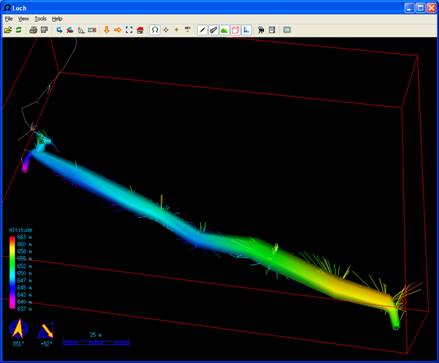
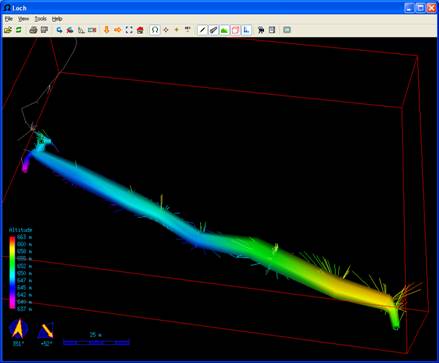
Paperless survey (no LRUD), walls auto, off or on (or not specified), No plan scraps. [**Loch** always guesses tube dimensions]****
-same if LRUD present and walls off****
** **
****
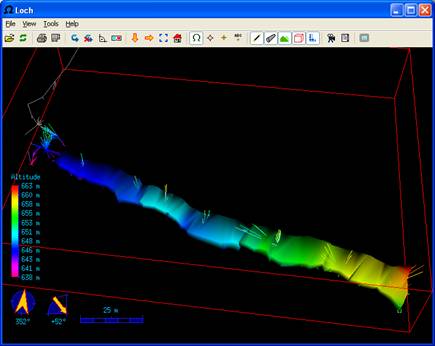
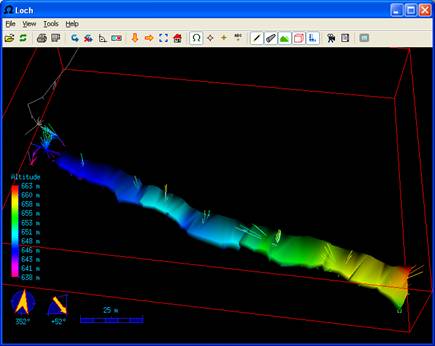
Paperless survey (no LRUD), walls auto, off or on (or not specified), plan scraps drawn [**Loch** uses scraps for tube width and guesses tube height] ****
** **
** **
Now, I added a few LRUD to the same centreline, including some with only UD ****
** **
data dimensions station left right up down****
1.4 - - 20 20****
1.5 - - 20 20****
1.6 2 2 20 20****
****
3.13 10 10 20 20****
3.14 10 10 20 20****
** **
Tube generation, where it occurs extends one station beyond those specified.****
** **
****
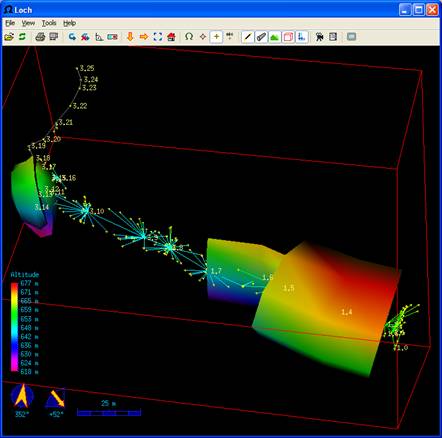
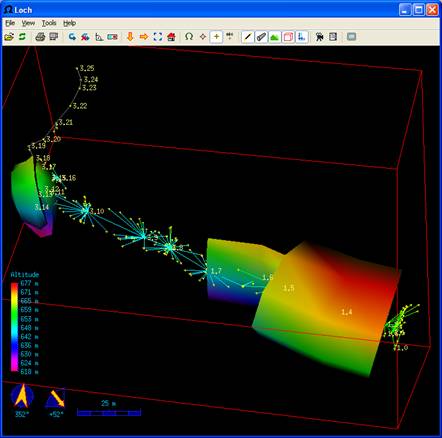
Paperless survey (some LRUD), walls on or auto (or not specified), No plan scraps. [**Loch** uses LRUD for tube dimensions and only for stations where partial data is provided, it guesses the missing data ie if a station has no data, no tube is generated]****
** **
And now adding some scraps and things get interesting.****
** **
****
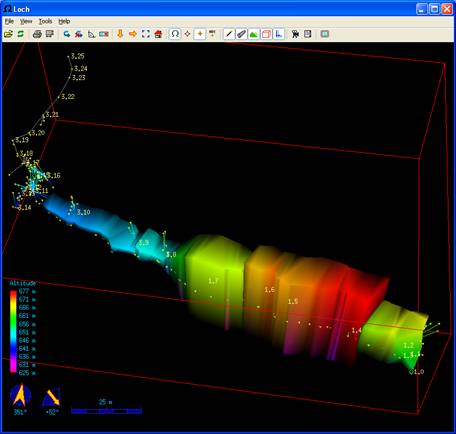
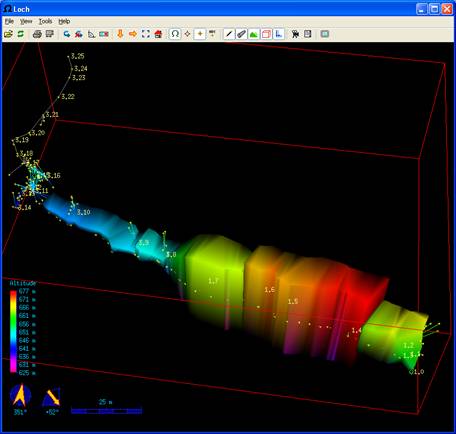
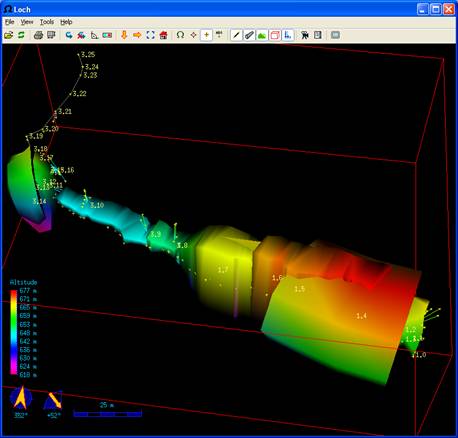
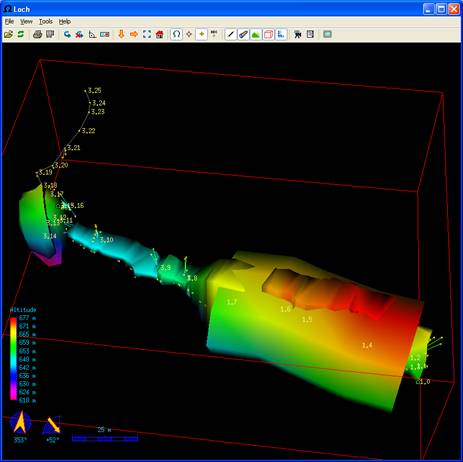
Paperless survey (some LRUD), walls off (or not specified), Plan scraps drawn. [**Loch** uses scraps, not LR, for tube plan dimensions, and UD for height where specified, otherwise height is guessed. Where there are no scraps, LRUD is *not* used.]****
That is perhaps contrary to what one might expect from the Therion Book ‘walls’ entry. It also produces perhaps the best model.****
****
Paperless survey (some LRUD), walls on or auto, Plan scraps drawn. [**Loch ** uses scraps AND LR for tube plan dimensions, and UD for height where specified, otherwise height is guessed. Where there is no LR, then it is guessed. Where there are no scraps, LRUD *is* used.]****
** **
If I change the LRUD definition like this…****
** **
data dimensions station up down****
1.4 20 20****
1.5 20 20****
1.6 20 20****
data dimensions station left right up down ****
3.13 10 10 20 20****
3.14 10 10 20 20****
** **
..then the guessed width troubles continue.****
****
Paperless survey (some LRUD), walls on or auto, Plan scraps drawn. [same as above]****
** **
So my final conclusion, for paperless survey, no need to include walls statements in each survey, or if you do, walls off is better than on or auto. If you happen to provide some UD data, then your model will be improved (more realistic).****
** **
I surmise that with these same settings, scraps with point passage-height or point dimensions will have a similar effect, but I have not tested this. ****
** **
Bruce****
** **
** **
_______________________________________________ Therion mailing list Therion@speleo.sk http://mailman.speleo.sk/mailman/listinfo/therion
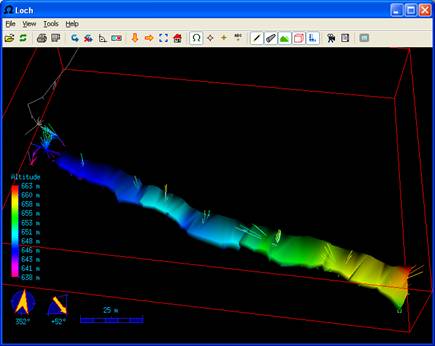
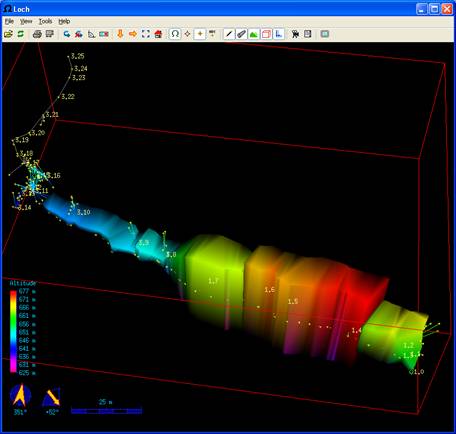

Bruce a very useful article but it differs from my experience in a couple of ways. I thought a couple of months ago I would try and produce a reasonable 3d model of a cave. So I surveyed a short section of passage with more data than I could possibly normally use. I set stations at 5m intervals and took 8 wall measurements every 1m. This would get me a lot of splays that I could then use as vertices for a 3d model (if I could find/write some software to make the model, not done yet) I could then compare this model with the one Therion produces and see which extra splays are really needed. Unlike your models I seem to get the centreline tube in the middle (mostly) of the scrap tube. Unfortunately this centreline tube often protrudes through the scrap tube, ruining the model. How am I getting two tube? I have tried various options with walls on/off/auto or commented out, to no avail. I also found the Dimensions –value [up, down] useful but it sometimes does unexpected things. Passage Height was even worse for this. If a single number was given it distributed the measurement above and below the centreline. If + – was used it appeared on the plan but did nothing on the model. using Therion 5.3.11 This is a work in progress and your mail has come at just the right time Cheers John From: Bruce Sent: Saturday, July 20, 2013 11:12 PM To: 'List for Therion users' Subject: [Therion] Loch passage tube behaviour Footleg I think the answer is ‘yes’. Hopefully you can view the images embedded in the image rather than attached, otherwise this won’t make much sense. In this example there is a single centreline (comprising both cave and surface survey) and 4 scraps. A short section of cave at the left hand end does not have any scrap drawn. Compiled with Therion 5.3.11 One interesting point is that regardless of the ‘walls’ setting, there is never a tube generated there once we have scraps drawn anywhere in this centreline. My deduction is that Loch uses only one type of tube generation per centreline, because in almost all my larger projects that transition between traditional survey and paperless survey, I have a combination of each type of tube generation within the same Loch model. This fits with the description in the Therion Book “walls <auto/on/off> turn on/off passage shape generation from LRUD data for subsequent shots. If set auto, passage is generated only if there is no scrap referencing given centreline.” In these examples I have not used any ‘point passage-height’ or ‘point dimensions’ in the scraps. Paperless survey (no LRUD), walls auto, off or on (or not specified), No plan scraps. [Loch always guesses tube dimensions] -same if LRUD present and walls off Paperless survey (no LRUD), walls auto, off or on (or not specified), plan scraps drawn [Loch uses scraps for tube width and guesses tube height] Now, I added a few LRUD to the same centreline, including some with only UD data dimensions station left right up down 1.4 - - 20 20 1.5 - - 20 20 1.6 2 2 20 20 3.13 10 10 20 20 3.14 10 10 20 20 Tube generation, where it occurs extends one station beyond those specified. Paperless survey (some LRUD), walls on or auto (or not specified), No plan scraps. [Loch uses LRUD for tube dimensions and only for stations where partial data is provided, it guesses the missing data ie if a station has no data, no tube is generated] And now adding some scraps and things get interesting. Paperless survey (some LRUD), walls off (or not specified), Plan scraps drawn. [Loch uses scraps, not LR, for tube plan dimensions, and UD for height where specified, otherwise height is guessed. Where there are no scraps, LRUD is not used.] That is perhaps contrary to what one might expect from the Therion Book ‘walls’ entry. It also produces perhaps the best model. Paperless survey (some LRUD), walls on or auto, Plan scraps drawn. [Loch uses scraps AND LR for tube plan dimensions, and UD for height where specified, otherwise height is guessed. Where there is no LR, then it is guessed. Where there are no scraps, LRUD is used.] If I change the LRUD definition like this… data dimensions station up down 1.4 20 20 1.5 20 20 1.6 20 20 data dimensions station left right up down 3.13 10 10 20 20 3.14 10 10 20 20 ..then the guessed width troubles continue. Paperless survey (some LRUD), walls on or auto, Plan scraps drawn. [same as above] So my final conclusion, for paperless survey, no need to include walls statements in each survey, or if you do, walls off is better than on or auto. If you happen to provide some UD data, then your model will be improved (more realistic). I surmise that with these same settings, scraps with point passage-height or point dimensions will have a similar effect, but I have not tested this. Bruce -------------------------------------------------------------------------------- _______________________________________________ Therion mailing list Therion@speleo.sk http://mailman.speleo.sk/mailman/listinfo/therion -------------------------------------------------------------------------------- No virus found in this message. Checked by AVG - www.avg.com Version: 2013.0.3349 / Virus Database: 3204/6507 - Release Date: 07/20/13
Interesting John With your model as posted I did not get dual tubes with walls off although I did with walls on. If you remove all of the point passage-height and point dimensions from your scrap, then the behaviour of your model seems to match the behaviour I described. BTW I added my previous post to the wiki examples page http://therion.speleo.sk/wiki/doku.php/examples#loch_models_paperless_survey _plan_scraps_and_lrud Not able to spend more time on this just now (winter sniffles-back to bed), but seems like point dimensions and point passage-height changes the behaviour. A semi automated way of enabling therion to produce accurate model passage heights using splay shots would be useful, and it seems like Footlegs proposal might be convenient (for those of us who don't have to write the code). Bruce _____ From: therion-bounces@speleo.sk [mailto:therion-bounces@speleo.sk] On Behalf Of John Stevens Sent: Wednesday, 24 July 2013 7:03 a.m. To: 'List for Therion users' Subject: Re: [Therion] Loch passage tube behaviour Bruce a very useful article but it differs from my experience in a couple of ways. I thought a couple of months ago I would try and produce a reasonable 3d model of a cave. So I surveyed a short section of passage with more data than I could possibly normally use. I set stations at 5m intervals and took 8 wall measurements every 1m. This would get me a lot of splays that I could then use as vertices for a 3d model (if I could find/write some software to make the model, not done yet) I could then compare this model with the one Therion produces and see which extra splays are really needed. Unlike your models I seem to get the centreline tube in the middle (mostly) of the scrap tube. Unfortunately this centreline tube often protrudes through the scrap tube, ruining the model. How am I getting two tube? I have tried various options with walls on/off/auto or commented out, to no avail. I also found the Dimensions -value [up, down] useful but it sometimes does unexpected things. Passage Height was even worse for this. If a single number was given it distributed the measurement above and below the centreline. If + - was used it appeared on the plan but did nothing on the model. using Therion 5.3.11 This is a work in progress and your mail has come at just the right time Cheers John
participants (3)
-
 Bruce
-
 Footleg
-
 John Stevens