Entering survey sketch without walls

Hello everyone - Yesterday we started a survey project in an abandoned mine. This is a room-and-pillar limestone mine all on one level. The mine is claimed to cover 35 acres (about 14 hectares). We ran centerline around part of the periphery for a bit over 3000 feet and came nowhere near to finishing. There was no sketch because we were really looking to place some of the entrances. The mine is a known hibernaculum for tri-color bats which will soon be on the endangered species list. It is also an attractive nuisance. There have been several "lost person/out of light" rescues in there, and many drunken parties. The mine is owned by a municipality. Financial resources are in place to gate all entrances, probably during summer 2025 after the bats leave. Looking forward, we ARE going to do a full cartographic map of this mine. That leads to my question for this group. When we start doing sketch, there will be many sections that have no outside wall at all. There will be inside wall to define the pillars. Therion has a very strong dependency on walls. How can sketch like this be used in Therion? I would be very glad to have hints and tips from anyone who has done a survey like this. Thanks! -- =============== Bill Gee

Hi Bill,
When we start doing sketch, there will be many sections that have no outside wall at all. There will be inside wall to define the pillars. Therion has a very strong dependency on walls.
If at all possible, end your surveys in passages, not at the junctions. Imagine a worst case scenario, where the passages (shown here in black) look like this, and this is the entire mine (case 1): ╋╋╋╋╋╋╋╋ ╋╋╋╋╋╋╋╋ ╋╋╋╋╋╋╋╋ ╋╋╋╋╋╋╋╋ (Hopefully, your computer draws that as a grid of + symbols.) Always start and end surveys half way down a passage, so that your days' surveys look like this (case 2): ╋╋╋ ╋╋ ╋ With little stub passages coming off each junction. The worst case would be a very short survey that looks like this (case 3): ╋ Let's take case 3 first, which should look like a simple + symbol. That is a simple survey, just like any other cave. The walls just look like this (hopefully your computer shows a simple pair of walls with open ends, around the inner unshaded + symbol): ╬ That is exactly how you would normally draw a cave. Now the problem is that Therion might see the walls being shorter than the open passage, so it might not know how to join the lines to fill in the cave properly (you will see that if you enable a background colour), because the walls need to be longer than the gaps at the open end of a passage in Therion, for it to work things out automatically. The solution to that is to draw an invisible wall across the open ends of the passages. Now that will mess up Therion's automatic scrap joins - which it bases on open wall ends - so I would personally use "line border" with "-outline out", and make it invisible. Then the wall lines can join another scrap's wall lines automatically. Make sense? OK, on to case 2, assuming you draw it as a single scrap. That is the same basic thing, but with one inner pillar: ╬╬╬ ╬╬ ╬ So you just set that inner pillar's wall to "-outline in", like you normally would for an oxbow. Case 1 is just case 2 with more inner walls. Hopefully that makes sense. The main thing for you, is to remember not to end your surveys at a junction, or you will hate yourself later when you get all the unpainted holes between your surveys (which have to be fixed with some invisible walls and a lot of manual line joining). End it *before* or *after* the junction. Let me know if that needed clarification. Tarquin
Hi Tarquin - Thanks for the hints and tips. I have encountered problems with Therion where scraps are wider than long. In one case I defined an invisible wall to close it off. For this case, though, that will not work. There are no passages in this mine. Think of a large room in a building with support columns in the middle. The limestone columns are typically 20 to 30 feet in diameter and located about every 80 to 100 feet. It is FAR more open space than columns. =============== Bill Gee On 12/3/24 08:40, Tarquin Wilton-Jones via Therion wrote:
Hi Bill,
When we start doing sketch, there will be many sections that have no outside wall at all. There will be inside wall to define the pillars. Therion has a very strong dependency on walls.
If at all possible, end your surveys in passages, not at the junctions. Imagine a worst case scenario, where the passages (shown here in black) look like this, and this is the entire mine (case 1):
╋╋╋╋╋╋╋╋ ╋╋╋╋╋╋╋╋ ╋╋╋╋╋╋╋╋ ╋╋╋╋╋╋╋╋
(Hopefully, your computer draws that as a grid of + symbols.) Always start and end surveys half way down a passage, so that your days' surveys look like this (case 2):
╋╋╋ ╋╋ ╋
With little stub passages coming off each junction. The worst case would be a very short survey that looks like this (case 3):
╋
Let's take case 3 first, which should look like a simple + symbol. That is a simple survey, just like any other cave. The walls just look like this (hopefully your computer shows a simple pair of walls with open ends, around the inner unshaded + symbol):
╬
That is exactly how you would normally draw a cave.
Now the problem is that Therion might see the walls being shorter than the open passage, so it might not know how to join the lines to fill in the cave properly (you will see that if you enable a background colour), because the walls need to be longer than the gaps at the open end of a passage in Therion, for it to work things out automatically. The solution to that is to draw an invisible wall across the open ends of the passages. Now that will mess up Therion's automatic scrap joins - which it bases on open wall ends - so I would personally use "line border" with "-outline out", and make it invisible. Then the wall lines can join another scrap's wall lines automatically. Make sense?
OK, on to case 2, assuming you draw it as a single scrap. That is the same basic thing, but with one inner pillar:
╬╬╬ ╬╬ ╬
So you just set that inner pillar's wall to "-outline in", like you normally would for an oxbow.
Case 1 is just case 2 with more inner walls.
Hopefully that makes sense.
The main thing for you, is to remember not to end your surveys at a junction, or you will hate yourself later when you get all the unpainted holes between your surveys (which have to be fixed with some invisible walls and a lot of manual line joining). End it *before* or *after* the junction.
Let me know if that needed clarification.
Tarquin _______________________________________________ Therion mailing list Therion@speleo.sk https://mailman.speleo.sk/listinfo/therion
For this case, though, that will not work. There are no passages in this mine. Think of a large room in a building with support columns in the middle.
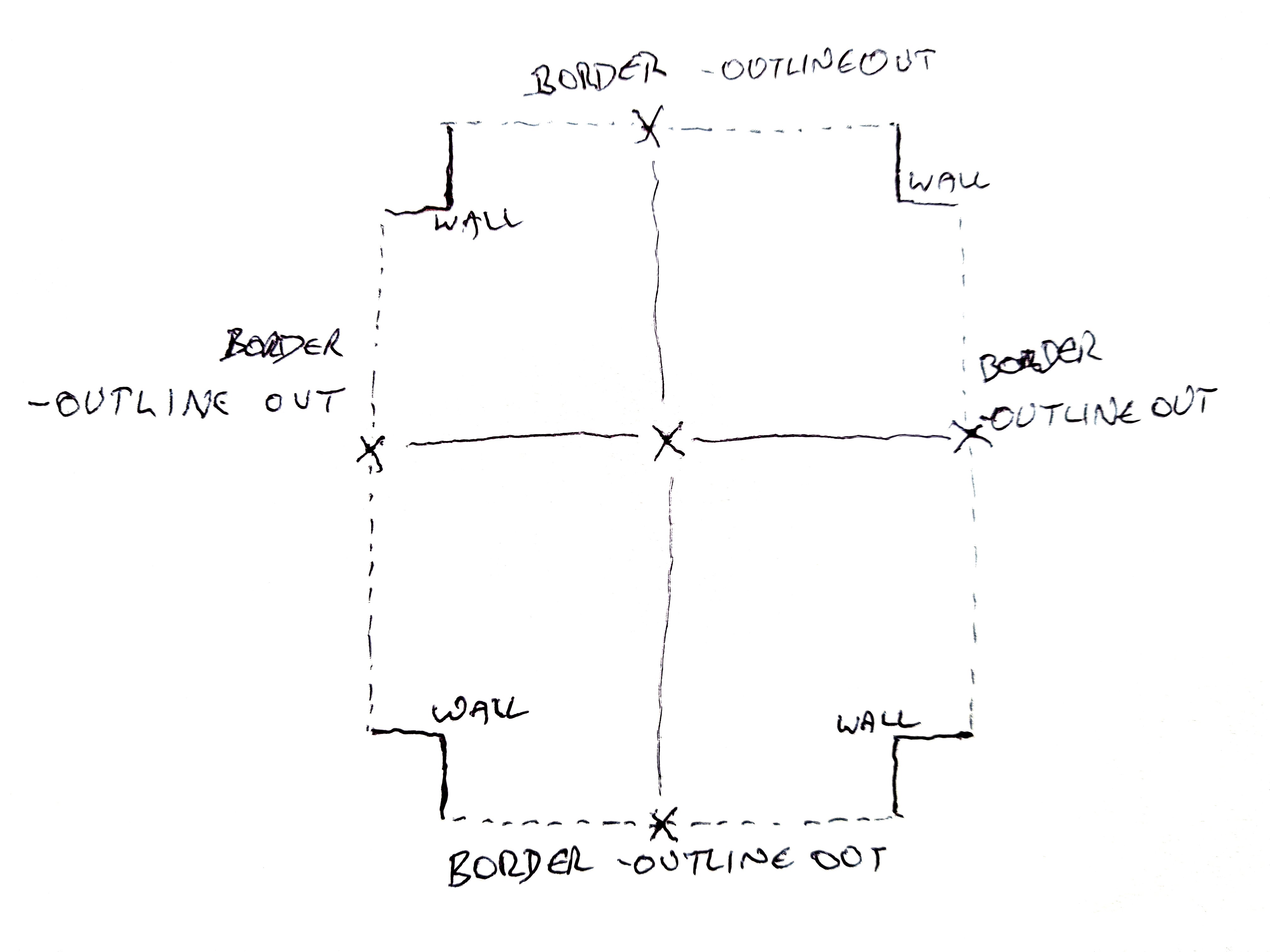
You have to change your mindset. It *is* a series of passages. They are just very short before reaching the next junction. And just like if you were surveying a cave passage 100 metres wide and 50 metres long, you have to draw the walls, and close the gaps between them with an outline. See attached (case 3).
Hmmm... I thought about doing it the way you suggest. I will have to try it to see how it works. Testing required1 :-) I think a lot would depend on how the survey shots are laid out. I think it would require several survey stations around each column. The scrap boundaries would then be the surveyed line between adjacent columns. And I suspect there would be a very large number of explicit line joins. Some adjustment, of course, since the columns are not laid out in a regular grid. There would be some triangular scraps. Would it work better to set a survey station in the center of an intersection and then do splay shots to the columns? Or set the stations on the columns? =============== Bill Gee On 12/3/24 09:02, Tarquin Wilton-Jones via Therion wrote:
For this case, though, that will not work. There are no passages in this mine. Think of a large room in a building with support columns in the middle.
You have to change your mindset. It *is* a series of passages. They are just very short before reaching the next junction. And just like if you were surveying a cave passage 100 metres wide and 50 metres long, you have to draw the walls, and close the gaps between them with an outline. See attached (case 3).
_______________________________________________ Therion mailing list Therion@speleo.sk https://mailman.speleo.sk/listinfo/therion
I think a lot would depend on how the survey shots are laid out. I think it would require several survey stations around each column.
In my sketch, the survey stations are marked with an X, and the legs are paint lines between them. You really just need to make sure that no matter what there are stations in between the junctions for every place you want to end a survey (or sketch). You only need them in those positions at the *end* of each day's surveying. They don't need to be in the middle of a passage, just not on the corner of a pillar.
And I suspect there would be a very large number of explicit line joins.
If you do it the way I said (using a border line instead of an invisible wall), hopefully you just need to tell Therion how many passages to join, and it will do it.
Would it work better to set a survey station in the center of an intersection and then do splay shots to the columns? Or set the stations on the columns?
It shouldn't matter, as long as you can splay what you need, and make legs that have a sane direction, not ridiculous zig-zags (which add to your survey length). The only place where the position of a station really matters is at the edges of the day's survey (or scrap), where it has to join another survey. That must not be in the middle of a junction, r you will hate yourself. It needs to be part way into a "passage".

using a border line instead of an invisible wall for scrap borders in centre of a passage / open space
There are a number of considerations here. This wiki post describes them https://therion.speleo.sk/wiki/drawingchecklist#wall It may be that using line wall -visibility off is a better solution than either line wall -subtype invisible or line border -outline out -visibility off Tarquin’s overall approach is how I would do it. Always end/start surveys between pillars, and each open end of a scrap only joins with one other scrap, to avoid the open triangle in the apparent interior of the cave. Even if you make a mistake in the field and end a survey in the middle of a void far from the pillars, strategic drawing of the scrap walls can mitigate the problem. Imagine Tarquin’s sketch attachment with say the left-hand survey station missing, so the station joining with another survey to the left is in the centre of the void. So you draw the sketch exactly as Tarquin has (with walls defining the pillars at distant-left, just there is no station between them) and it will work. See also https://therion.speleo.sk/wiki/faq#how_do_i_join_three_scraps_in_a_y-shape. The XTherion ‘tricky’ image demonstrates a simple case. What is really happening is that a three-scrap join is turned into a series of two-scrap joins. These can then be joined semi-automatically as described in https://therion.speleo.sk/wiki/tips#joining_scraps_together Bruce
Thank you Bruce and Tarquin for the ideas. I decided to make a practice map so I could see how all this actually works. The results are ... Interesting! This zip file contains the entire project. https://campercaver.net/MiscFiles/PracticeMine.zip There are several versions of the map which I did as I added objects to it. The last two runs are PracticeMine-4.0.pdf and PracticeMine.pdf. The only difference between the two is the addition of a "join" line in the .th file. Wow, did that ever drive Therion crazy! Going back to the 4.0 map - I can easily add a join between the two walls on the east side. The thing I am wondering about is how the columns are drawn. There is a white triangle in the middle of the map which show where the two scraps come together. Two columns are split across the connection. I drew them with "-outline in" on one scrap and did not draw them at all on the second. If I draw only that part of the column which is in each scrap, can I still use "-outline in"? Will I need to use line joins to get the two parts of the column to come together? And will that result in a column that is entirely white on the inside? =============== Bill Gee On 12/3/24 13:06, Bruce Mutton wrote:
using a border line instead of an invisible wall for scrap borders in centre of a passage / open space
There are a number of considerations here. This wiki post describes them https://therion.speleo.sk/wiki/drawingchecklist#wall <https:// therion.speleo.sk/wiki/drawingchecklist#wall>
It may be that using line wall -visibility off is a better solution than either line wall -subtype invisible or line border -outline out - visibility off
Tarquin’s overall approach is how I would do it. Always end/start surveys between pillars, and each open end of a scrap only joins with one other scrap, to avoid the open triangle in the apparent interior of the cave. Even if you make a mistake in the field and end a survey in the middle of a void far from the pillars, strategic drawing of the scrap walls can mitigate the problem. Imagine Tarquin’s sketch attachment with say the left-hand survey station missing, so the station joining with another survey to the left is in the centre of the void. So you draw the sketch exactly as Tarquin has (with walls defining the pillars at distant-left, just there is no station between them) and it will work.
See also https://therion.speleo.sk/wiki/ faq#how_do_i_join_three_scraps_in_a_y-shape <https://therion.speleo.sk/ wiki/faq#how_do_i_join_three_scraps_in_a_y-shape>. The XTherion ‘tricky’ image demonstrates a simple case. What is really happening is that a three-scrap join is turned into a series of two-scrap joins. These can then be joined semi-automatically as described in https:// therion.speleo.sk/wiki/tips#joining_scraps_together <https:// therion.speleo.sk/wiki/tips#joining_scraps_together>
Bruce
_______________________________________________ Therion mailing list Therion@speleo.sk https://mailman.speleo.sk/listinfo/therion

This could be a problem in model, because yellow tick should allways direct to empty space (air). You may correct it just add -reverse to line. M.
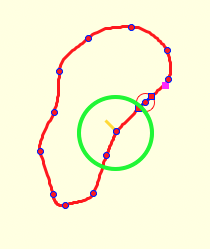
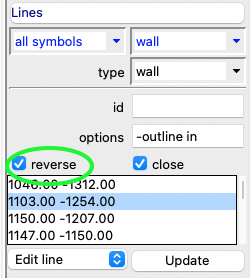
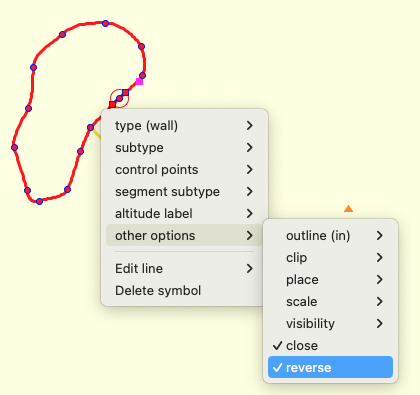
If I draw only that part of the column which is in each scrap, can I still use "-outline in"? No, those remain -outline out. Also your sketches for surveys should not include the parts of the pillar walls that have not been surveyed!
Will I need to use line joins to get the two parts of the column to come together? No, use join scrap1 scrap2 -count 2 And you will need to replace line wall -subtype invisible with line wall -visibility off as is intimated in https://therion.speleo.sk/wiki/drawingchecklist#wall
And will that result in a column that is entirely white on the inside? Yes, but only once you have all wall lines in place and parameters for all lines correct (-reverse, -outline, -subtype, -visibility)
Bruce
I gave this a try ... I drew partial pillars on the edge of each scrap using a normal wall line. I changed the straight lines between the pillars to -visibility off, and I added a "join scrap1 scrap2 -count 2" to the .th file. The result is not quite as badly mangled, but it is still not right. Taking out the join statement gives a map that makes more sense. There are still some artifacts where the two scraps join, and the walls on the pillar between those two scraps don't line up quite right. I also tried it using "join scrap1 scrap2" and no -count option. That produced a reasonable map. The wall on the east side now has a smooth join. The pillar in the middle still has discontinuities. I checked the "reverse" box on the pillars which are completely contained in a scrap. It made no difference I can see. When I drew those lines, I went in a counter-clockwise direction. On the upper scrap I drew lines between the pillars. I did not draw those same lines on the lower scrap. Is that needed? One thing that is very apparent here is that the in-cave survey and sketching will have to be done exactly right. Two attached PDF files, one with the "join count 2" statement and the other with no join statement. =============== Bill Gee On 12/5/24 13:19, Bruce Mutton wrote:
If I draw only that part of the column which is in each scrap, can I still use "-outline in"? No, those remain -outline out. Also your sketches for surveys should not include the parts of the pillar walls that have not been surveyed!
Will I need to use line joins to get the two parts of the column to come together? No, use join scrap1 scrap2 -count 2 And you will need to replace line wall -subtype invisible with line wall -visibility off as is intimated in https://therion.speleo.sk/wiki/drawingchecklist#wall
And will that result in a column that is entirely white on the inside? Yes, but only once you have all wall lines in place and parameters for all lines correct (-reverse, -outline, -subtype, -visibility)
Bruce
_______________________________________________ Therion mailing list Therion@speleo.sk https://mailman.speleo.sk/listinfo/therion
Bill My hierarchy of considerations when I work through this type of drawing: * Colour map-fg scrap - ensures you can see scrap edges while you are working (not relevant to your current example, but if helpful when the project gets bigger) * Make sure yellow ticks point into the cave void ie -reverse status (not usually ‘necessary’ for pdf outputs, but affects kml significantly, and I suspect sometimes affects scrap joins) * Only create non-visible walls in open scrap ends if necessary, based on trial and error. Usually, they are necessary where the open end of a scrap is wider that the scrap is long. * Think carefully about -outline status and the type of line it is attached to. Kml are particularly sensitive, and a good tool for checking this and all the above points. * Only explicitly join scraps and lines if absolutely necessary ie based on trial and error (your example shows that some form of join is necessary in this case). Start with simplest join approach and progressively try more constrained approaches (no count option, -count 1, -count 2). Manual or point by point joins are a last resort, and should not be required for what appear to be simple open ends of scraps. My experience is that while it pays to be aware of Therion considerations when surveying, pretty much any in-cave survey centreline misdemeanour can be accommodated when drawing scraps. Some are easier, some are harder and experience helps. Usually an apparently intractable problem can be traced to an errant object or property that you haven’t noticed. This wiki entry might be helpful https://therion.speleo.sk/wiki/faq?s[]=distortion#how_do_i_use_debug_mode_in_layout_visualising_drawing_errors_and_distortion <https://therion.speleo.sk/wiki/faq?s%5b%5d=distortion#how_do_i_use_debug_mode_in_layout_visualising_drawing_errors_and_distortion> layout LayoutDistortion listed therein can help pin down the cause of unexpected problems. Good luck Bruce
Check if there is not a double station in a scrap - squezed pillar. Martin Odesláno z iPhonu
5. 12. 2024 v 22:40, Bill Gee <bgee@campercaver.net>:
I gave this a try ... I drew partial pillars on the edge of each scrap using a normal wall line. I changed the straight lines between the pillars to -visibility off, and I added a "join scrap1 scrap2 -count 2" to the .th file. The result is not quite as badly mangled, but it is still not right.
Taking out the join statement gives a map that makes more sense. There are still some artifacts where the two scraps join, and the walls on the pillar between those two scraps don't line up quite right.
I also tried it using "join scrap1 scrap2" and no -count option. That produced a reasonable map. The wall on the east side now has a smooth join. The pillar in the middle still has discontinuities.
I checked the "reverse" box on the pillars which are completely contained in a scrap. It made no difference I can see. When I drew those lines, I went in a counter-clockwise direction.
On the upper scrap I drew lines between the pillars. I did not draw those same lines on the lower scrap. Is that needed?
One thing that is very apparent here is that the in-cave survey and sketching will have to be done exactly right.
Two attached PDF files, one with the "join count 2" statement and the other with no join statement.
=============== Bill Gee
On 12/5/24 13:19, Bruce Mutton wrote:
If I draw only that part of the column which is in each scrap, can I still use "-outline in"? No, those remain -outline out. Also your sketches for surveys should not include the parts of the pillar walls that have not been surveyed! Will I need to use line joins to get the two parts of the column to come together? No, use join scrap1 scrap2 -count 2 And you will need to replace line wall -subtype invisible with line wall -visibility off as is intimated in https://therion.speleo.sk/wiki/drawingchecklist#wall And will that result in a column that is entirely white on the inside? Yes, but only once you have all wall lines in place and parameters for all lines correct (-reverse, -outline, -subtype, -visibility) Bruce
Therion mailing list Therion@speleo.sk https://mailman.speleo.sk/listinfo/therion <PracticeMine-WithJoin.pdf> <PracticeMine-WithoutJoin.pdf>
Therion mailing list Therion@speleo.sk https://mailman.speleo.sk/listinfo/therion
By "double station" you mean two survey stations at the same location - right? I did a grep on the .th2 files and found no stations where the point coordinates were the same, and also no instance of two stations with the same name in one scrap. There are three stations which exist in both scraps, but that should not be a problem. They are on the seam between the scraps. I think the next thing for me to do is create another scrap or two and see how they can be made to fit in. =============== Bill Gee On 12/6/24 02:25, Martin Sluka via Therion wrote:
Check if there is not a double station in a scrap - squezed pillar.
Martin
Odesláno z iPhonu
5. 12. 2024 v 22:40, Bill Gee <bgee@campercaver.net>:
I gave this a try ... I drew partial pillars on the edge of each scrap using a normal wall line. I changed the straight lines between the pillars to -visibility off, and I added a "join scrap1 scrap2 -count 2" to the .th file. The result is not quite as badly mangled, but it is still not right.
Taking out the join statement gives a map that makes more sense. There are still some artifacts where the two scraps join, and the walls on the pillar between those two scraps don't line up quite right.
I also tried it using "join scrap1 scrap2" and no -count option. That produced a reasonable map. The wall on the east side now has a smooth join. The pillar in the middle still has discontinuities.
I checked the "reverse" box on the pillars which are completely contained in a scrap. It made no difference I can see. When I drew those lines, I went in a counter-clockwise direction.
On the upper scrap I drew lines between the pillars. I did not draw those same lines on the lower scrap. Is that needed?
One thing that is very apparent here is that the in-cave survey and sketching will have to be done exactly right.
Two attached PDF files, one with the "join count 2" statement and the other with no join statement.
=============== Bill Gee
On 12/5/24 13:19, Bruce Mutton wrote:
If I draw only that part of the column which is in each scrap, can I still use "-outline in"? No, those remain -outline out. Also your sketches for surveys should not include the parts of the pillar walls that have not been surveyed! Will I need to use line joins to get the two parts of the column to come together? No, use join scrap1 scrap2 -count 2 And you will need to replace line wall -subtype invisible with line wall -visibility off as is intimated in https://therion.speleo.sk/wiki/drawingchecklist#wall And will that result in a column that is entirely white on the inside? Yes, but only once you have all wall lines in place and parameters for all lines correct (-reverse, -outline, -subtype, -visibility) Bruce
Therion mailing list Therion@speleo.sk https://mailman.speleo.sk/listinfo/therion <PracticeMine-WithJoin.pdf> <PracticeMine-WithoutJoin.pdf>
Therion mailing list Therion@speleo.sk https://mailman.speleo.sk/listinfo/therion
Therion mailing list Therion@speleo.sk https://mailman.speleo.sk/listinfo/therion
Misplaced station? Martin Odesláno z iPhonu
6. 12. 2024 v 13:59, Bill Gee <bgee@campercaver.net>:
By "double station" you mean two survey stations at the same location - right? I did a grep on the .th2 files and found no stations where the point coordinates were the same, and also no instance of two stations with the same name in one scrap.
There are three stations which exist in both scraps, but that should not be a problem. They are on the seam between the scraps.
I think the next thing for me to do is create another scrap or two and see how they can be made to fit in.
=============== Bill Gee
On 12/6/24 02:25, Martin Sluka via Therion wrote: Check if there is not a double station in a scrap - squezed pillar. Martin Odesláno z iPhonu
5. 12. 2024 v 22:40, Bill Gee <bgee@campercaver.net>:
I gave this a try ... I drew partial pillars on the edge of each scrap using a normal wall line. I changed the straight lines between the pillars to -visibility off, and I added a "join scrap1 scrap2 -count 2" to the .th file. The result is not quite as badly mangled, but it is still not right.
Taking out the join statement gives a map that makes more sense. There are still some artifacts where the two scraps join, and the walls on the pillar between those two scraps don't line up quite right.
I also tried it using "join scrap1 scrap2" and no -count option. That produced a reasonable map. The wall on the east side now has a smooth join. The pillar in the middle still has discontinuities.
I checked the "reverse" box on the pillars which are completely contained in a scrap. It made no difference I can see. When I drew those lines, I went in a counter-clockwise direction.
On the upper scrap I drew lines between the pillars. I did not draw those same lines on the lower scrap. Is that needed?
One thing that is very apparent here is that the in-cave survey and sketching will have to be done exactly right.
Two attached PDF files, one with the "join count 2" statement and the other with no join statement.
=============== Bill Gee
On 12/5/24 13:19, Bruce Mutton wrote:
If I draw only that part of the column which is in each scrap, can I still use "-outline in"? No, those remain -outline out. Also your sketches for surveys should not include the parts of the pillar walls that have not been surveyed! Will I need to use line joins to get the two parts of the column to come together? No, use join scrap1 scrap2 -count 2 And you will need to replace line wall -subtype invisible with line wall -visibility off as is intimated in https://therion.speleo.sk/wiki/drawingchecklist#wall And will that result in a column that is entirely white on the inside? Yes, but only once you have all wall lines in place and parameters for all lines correct (-reverse, -outline, -subtype, -visibility) Bruce
Therion mailing list Therion@speleo.sk https://mailman.speleo.sk/listinfo/therion <PracticeMine-WithJoin.pdf> <PracticeMine-WithoutJoin.pdf>
Therion mailing list Therion@speleo.sk https://mailman.speleo.sk/listinfo/therion
Therion mailing list Therion@speleo.sk https://mailman.speleo.sk/listinfo/therion
_______________________________________________ Therion mailing list Therion@speleo.sk https://mailman.speleo.sk/listinfo/therion
Bill I've been misleading you (and everyone). I should not multi-task quite so much. I will try to rectify the situation tomorrow with a sketch. In the meantime... line wall -subtype invisible is what should be used for the open ends of scraps in your example, and should allow semiautomatic joins. line wall -visibility off will preclude the possibility of semiautomatic joins, but does have a use case in large open voids that need to have a scrap join where there are no (real) walls at all. Manual point joins will be required across those boundaries. A sketch tomorrow… Bruce
Bill I’ve looked back through projects where I have made non-trivial and multi-scrap joins of scraps. My early attempts, prior to my understanding distilled in https://therion.speleo.sk/wiki/drawingchecklist#wall are characterised by brute strength manual joining of multiple points. Painful. More recent attempts strategically using line wall -visibility off and line wall -subtype invisible have almost always enabled semi-automatic joins (see https://therion.speleo.sk/wiki/tips#joining_scraps_together ) However, it seems not to be an exact science, and I have cases where a manual join should be required, but semi-automatic has sufficed. Also cases where I have resorted to a manual join when I though semi-automatic should do it. I’d be really pleased if someone can identify what the rest of the puzzle might be, or suggest improvement to those wiki pages. What works best for a particular project will probably depend on whether it is structured such that scraps can easily span multiple surveys or not. My projects are predisposed towards collections of scraps that can only reference one survey with ease. That is probably why I join scraps in the middle of a void more often than some (by often I mean perhaps a dozen times in 60 -80 km and 15 years – usually when part of a large chamber is resurveyed some years later, or when a chamber is highly undulating and it is not possible to see walls, and is surveyed on multiple trips). However don’t think differences in survey scrap relationship structures will change how join methods behave. Rendering discontinuities should be expected where scrap joins are more complex than ‘straight between two open passage ends’. If these bother you, then opting for some combination of the easiest, simplest, and ‘least morphing required’ will probably give the best result. The attached sketch shows how I might arrange multiple scraps in a large void. A simple 1 leg, 2 station survey with a minimal scrap as part of a much larger void and field of scraps. Actual visible walls or pillars in a particular scrap should not be necessary, although I don’t think I’ve done one (with interior shading) without any visible wall at all. Easiest option: As much sketched cave as possible in one contiguous image in each th2 file. Each scrap (and line and point) join is achieved fully automatically by snapping the points on top of each other. The -visibility and -subtype properties of wall lines are likely to be less relevant to join behaviour, because the morphing induced by the co-incident points dominates. Next option: Non-contiguous sketches or sketches/scraps in different th2 files. Semi-automatic joins required and sufficient here, in most cases. Sometimes manual joins are required across wall -visibility off boundaries. Last resort: Add manual joins only at specific locations where the above fails, or where you want to joint non-wall objects, such as passage feature objects. Bruce From: Therion <therion-bounces@speleo.sk> On Behalf Of Bruce Mutton Sent: Saturday, 7 December 2024 06:18 To: 'List for Therion users' <therion@speleo.sk> Subject: [Therion] Entering survey sketch without walls Bill I've been misleading you (and everyone). I should not multi-task quite so much. I will try to rectify the situation tomorrow with a sketch. In the meantime... line wall -subtype invisible is what should be used for the open ends of scraps in your example, and should allow semiautomatic joins. line wall -visibility off will preclude the possibility of semiautomatic joins, but does have a use case in large open voids that need to have a scrap join where there are no (real) walls at all. Manual point joins will be required across those boundaries. A sketch tomorrow… Bruce
Hi Bruce and everyone - I added two more scraps to my Practice Mine map. These scraps are completely interior - no walls, just columns. Using automatic join works quite well. There is one very small sliver between two of the scraps which might be related to inaccurate survey data. I had "line wall -visibility off" for the edges of every scrap. I took those lines out where two scraps meet - except for one which leaves a big white triangle. Odd. The "-visibility off" lines are still present around the edges of the scraps. I had to use one line join to get the actual wall to connect smoothly. When the time comes to do this for real, I can put those lines in as each scrap is drawn. Taking out the lines is easy. I might also use line joins for the columns that sit on scrap boundaries. The updated project files are at https://campercaver.net/MiscFiles/PracticeMine.zip. Compare PracticeMine-6.pdf and PracticeMine.pdf. The -6 file has all "-visibility off" lines present and uses a semi-automatic join between two scraps. The other two scraps are an automatic join. The file with no number takes out most of the hidden lines and uses all automatic joins except for the outer wall. It is worth noting that the centerline data is not very accurate. I drew the sketch on graph paper (scans are in the ZIP file) then used my cave protractor to measure the length and angle of each shot. It is probably not accurate to more than 3 degrees and 2 feet. A real in-cave survey with real numbers from a Disto will probably produce better joins. All of your advice and this practice map has taught me a lot. When the time comes to do the real map I have a good idea how to proceed. Thanks! =============== Bill Gee On 12/7/24 20:19, Bruce Mutton wrote:
Bill
I’ve looked back through projects where I have made non-trivial and multi-scrap joins of scraps.
My early attempts, prior to my understanding distilled in https:// therion.speleo.sk/wiki/drawingchecklist#wall <https://therion.speleo.sk/ wiki/drawingchecklist#wall> are characterised by brute strength manual joining of multiple points. Painful.
More recent attempts strategically using line wall -visibility off and line wall -subtype invisible have almost always enabled semi-automatic joins (see https://therion.speleo.sk/wiki/tips#joining_scraps_together <https://therion.speleo.sk/wiki/tips#joining_scraps_together> )
However, it seems not to be an exact science, and I have cases where a manual join should be required, but semi-automatic has sufficed. Also cases where I have resorted to a manual join when I though semi- automatic should do it. I’d be really pleased if someone can identify what the rest of the puzzle might be, or suggest improvement to those wiki pages.
What works best for a particular project will probably depend on whether it is structured such that scraps can easily span multiple surveys or not. My projects are predisposed towards collections of scraps that can only reference one survey with ease. That is probably why I join scraps in the middle of a void more often than some (by often I mean perhaps a dozen times in 60 -80 km and 15 years – usually when part of a large chamber is resurveyed some years later, or when a chamber is highly undulating and it is not possible to see walls, and is surveyed on multiple trips). However don’t think differences in survey scrap relationship structures will change how join methods behave.
Rendering discontinuities should be expected where scrap joins are more complex than ‘straight between two open passage ends’. If these bother you, then opting for some combination of the easiest, simplest, and ‘least morphing required’ will probably give the best result.
The attached sketch shows how I might arrange multiple scraps in a large void. A simple 1 leg, 2 station survey with a minimal scrap as part of a much larger void and field of scraps. Actual visible walls or pillars in a particular scrap should not be necessary, although I don’t think I’ve done one (with interior shading) without any visible wall at all.
*Easiest option:*
As much sketched cave as possible in one contiguous image in each th2 file. Each scrap (and line and point) join is achieved fully automatically by snapping the points on top of each other. The - visibilityand -subtypeproperties of wall lines are likely to be less relevant to join behaviour, because the morphing induced by the co- incident points dominates.
*Next option:*
Non-contiguous sketches or sketches/scraps in different th2 files. Semi-automatic joins required and sufficient here, in most cases. Sometimes manual joins are required across wall -visibility offboundaries.
*Last resort:*
Add manual joins only at specific locations where the above fails, or where you want to joint non-wall objects, such as passage feature objects.
Bruce
*From:*Therion <therion-bounces@speleo.sk> *On Behalf Of *Bruce Mutton *Sent:* Saturday, 7 December 2024 06:18 *To:* 'List for Therion users' <therion@speleo.sk> *Subject:* [Therion] Entering survey sketch without walls
Bill
I've been misleading you (and everyone). I should not multi-task quite so much. I will try to rectify the situation tomorrow with a sketch.
In the meantime...
line wall -subtype invisible is what should be used for the open ends of scraps in your example, and should allow semiautomatic joins.
line wall -visibility offwill preclude the possibility of semiautomaticjoins, but does have a use case in large open voids that need to have a scrap join where there are no (real) walls at all. Manual point joins will be required across those boundaries. A sketch tomorrow…
Bruce
_______________________________________________ Therion mailing list Therion@speleo.sk https://mailman.speleo.sk/listinfo/therion
Hi Bill, I changed the names of files and folders a bit: I edit .th file corresponding to modified names. I add one export to thconfig: #Map with names of scraps export map -o PracticeMine_debug.pdf -layout-debug on -layout-color map-fg scraps The result is attached. You may see, there are problematic pillars there. Martin
Hi Martin - Thanks! This is very useful as a debugging tool. As you note, it exposed some of my mistakes. I have made corrections. A bit of background: I generated the Practice Mine maps and data by first drawing the map freehand on graph paper. I marked and named survey stations on the drawing. From there I used my cave protractor to measure each survey line. Your debug map exposed some problems in the data that I read from my protractor. The distance for a few of the shots was off, and one survey station was in the wrong place on the Day4 sketch. I remeasured the shots, updated the centerline data file and recompiled the map. Attached is the result. This was compiled with the debug features turned on, as in your sample command line. It looks MUCH better! The debug map is very useful. I will start using it on other maps to help find blunders. =============== Bill Gee On 12/11/24 02:57, Martin Sluka via Therion wrote:
export map -o PracticeMine_debug.pdf -layout-debug on -layout-color map-fg scraps
participants (4)
-
 Bill Gee
-
 Bruce Mutton
-
 Martin Sluka
-
 Tarquin Wilton-Jones